Ecology
The Forth District is home to a host of mammal, fish, and bird species including many protected species and sites protected for these species.
One of the most recent arrivals includes the European beaver and we are listed on the NatureScot Beaver Framework. Please get in touch if you need any assistance from our knowledgeable team.
We offer a range of aquatic and terrestrial ecological services:
Fish ecology and passage
- Electrofishing and fish habitat survey
- Fish rescue
- Redd survey
- Fish barrier assessment (SNIFFER)
- Fish data requests
- Fishery policy, management, and advice
- Monitoring and mitigation
- Scientific studies and data analysis
- Barrier easement
Aquatic ecology
- Macroinvertebrate sampling and analysis
- Freshwater pearl mussel
- eDNA
- Great crested newt and amphibians
Terrestrial ecology
- Otter
- Beaver
- Water vole
- Badger
- Reptiles
- Bat call analysis
Ecological assessment and reporting
- Preliminary Ecological Appraisal
- Environmental management plans
- NatureScot licencing support
- Construction Environmental Management Plans (CEMP)
- Species protection plans
Ecological clerk of works
Ecological clerk of works
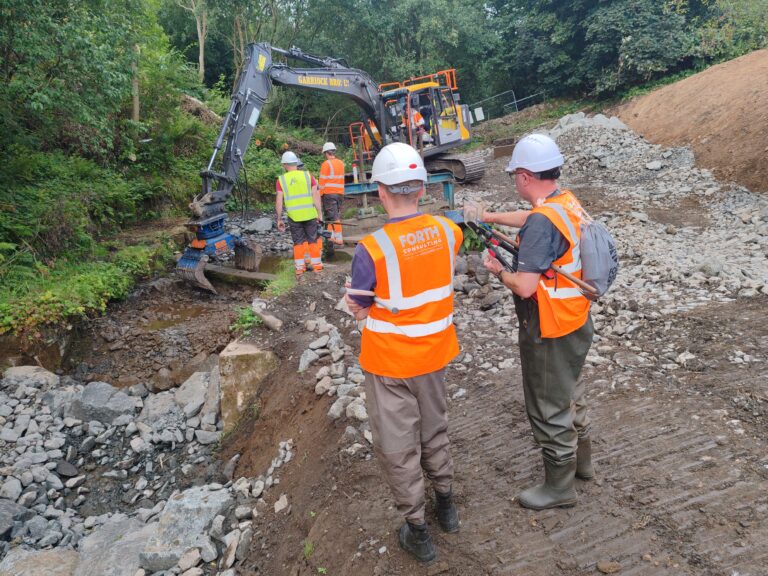
Forth Rivers Consulting were commissioned to undertake fish rescues and ecological clerk of works (ECoW) on the Water of Leith in Edinburgh as the Council employed Covanburn to undertake repair works on a hydroelectric weir. Brown trout and eel were present on site, as well as two otter families, with a holt not too far downstream. It was therefore important to ensure that the conditions of the NatureScot protected licence, SEPA CAR Licence, and those requested by the local fishery board were all adhered to, to ensure environmental compliance.
When the river was drained (with some clever handiwork from the FRC team to rescue two large brown trout from the pool), additional damage and a deeper-than-expected scour pool was uncovered requiring engineering redesign.
FRC worked with the council and contractor to ensure that otters and fish were protected throughout the works. This included limited hours of working throughout winter to avoid disturbing otters, and using washed gravel in the cofferdam, as type 1 or sand can damage the river substrate if released during a flood event.
Hover to read more
Protected species surveys
Through our connection with the Forth Rivers Trust, the FRC team are often asked to undertake protected species surveys throughout the catchment.
Recently, Amy and Jacquelyn visited a site on the Esk River in Midlothian. We found three badger latrines and identified one active sett on and around the works area. More surveys will be needed to determine how many badger clans are present in this area, and the river itself is likely to be a territorial boundary. For the purposes of any project work in this area, it is enough to know that badgers are present, and where they are crossing site in order to mitigate for them.
With beavers now present on the Forth District it is always exciting to visit an area of the catchment we haven’t been to in a while and find out where they have been. On the Allan Water this year, a trail camera identified pine marten, otter, beaver, kingfisher and fox using the same stretch of burn!

Hover to read more
Falkirk Wheel fish rescues
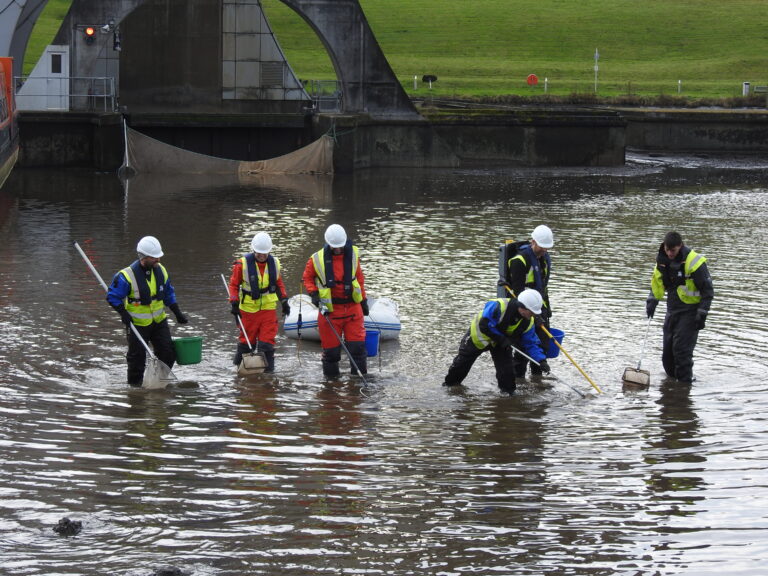
Forth Rivers Consulting have completed 7 years of fish rescues at the Falkirk Wheel ahead of their annual maintenance. The Falkirk Wheel fish rescue is the one of the largest and most complex fish rescue Forth Rivers Consulting encounter, rescuing over 1,000 fish a day.
Approximately 2,632 fish (mostly roach and perch with some pike, tench, brown trout, and eels) were rescued and released into adjacent sections of the canal in 2025.
The overall number of fish captured has been steadily increasing since 2020. As part of the project work, we produce graphs showing species composition by numbers and biomass and outputs on densities and length frequencies so that Scottish Canals can use this data.
A large adult pike captured in the upper basin was found to have multiple fishing hooks and line caught in its jaw which would have prevented it from eating. The fish rescue team, led by Alan Tragis, managed to successfully remove the line, giving this fish the best possible chance of survival upon release.
Hover to read more